
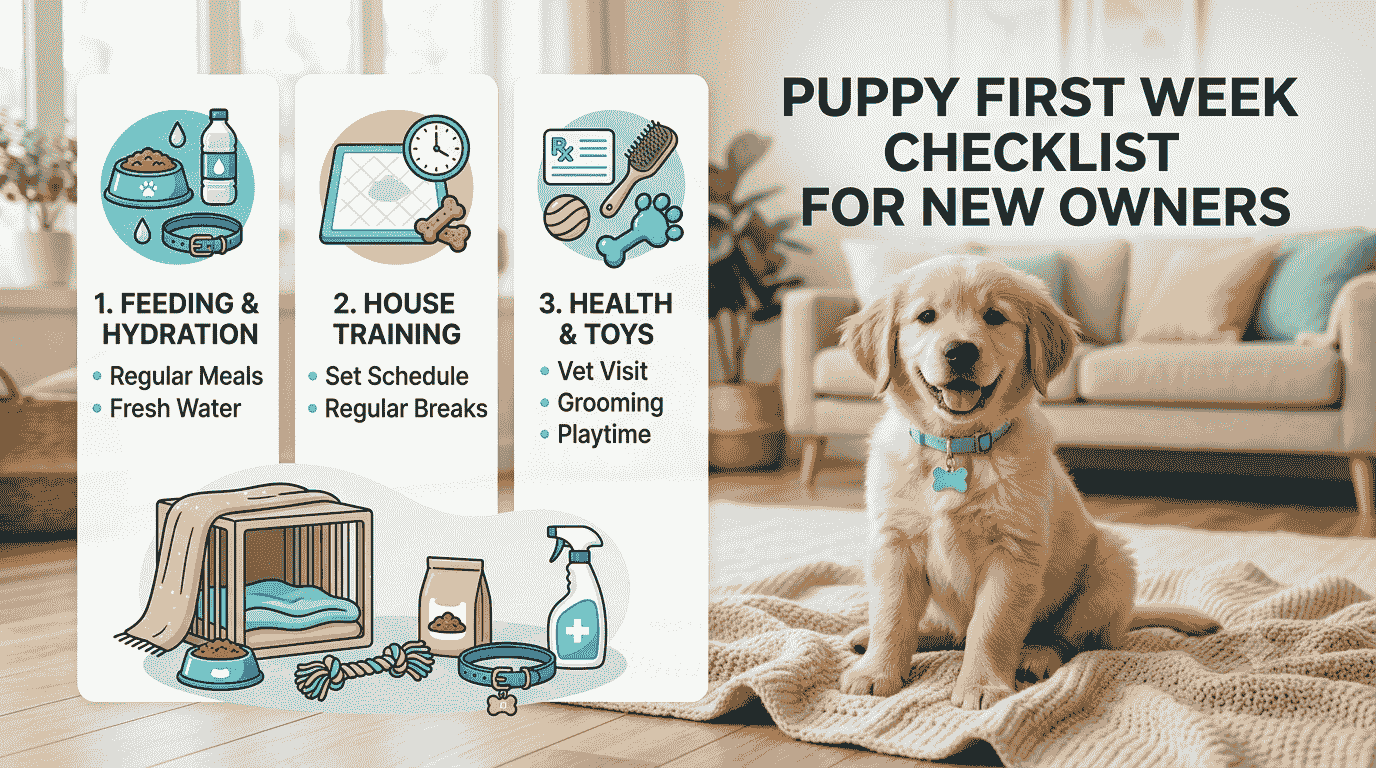
A puppy first week checklist built for real first-time owners — what to actually do, in what order, and what can wait until week two.
Puppy First Week Checklist for New Owners
The car ride home is the calm part. Nobody warns you about that. The puppy’s usually exhausted, curled up in someone’s lap, and you’re sitting there thinking okay, I think I have this handled — and then you walk in the door and it hits you that you don’t actually know what happens next.
That gap between “I did the research” and “I have a living animal in my kitchen at 11pm who won’t stop crying” is where most first week advice fails people. It’s not that the information is wrong. It’s that nobody tells you the order things actually happen in, or which parts you’re allowed to get wrong.
Here’s a first week that’s built around what actually needs to happen, roughly in the order it needs to happen, not a Pinterest board of things that would be nice.
Day One Isn’t for Training. It’s for Getting Through the Night.
Everyone’s instinct on day one is to start “doing things right” immediately — crate training, name recognition, the whole plan. Skip it. Day one is survival mode, both for the puppy and for you.
What actually matters on day one:
- A quiet, contained space — not the whole house, one room
- Water available at all times, food on a schedule (usually 3–4 times a day for a young puppy)
- A designated potty spot outside, and taking them there constantly — after eating, after waking up, after playing, roughly every 45 minutes to an hour
- Letting them sleep. A lot. Puppies sleep 18–20 hours a day and the first day in a new place is overwhelming even when it looks calm from the outside
The crying at night is normal. It’s not a sign you’ve done something wrong. It’s a puppy who, for the first time in its life, isn’t sleeping in a pile with littermates. A ticking clock wrapped in a towel near the crate, or a warm (not hot) water bottle, genuinely helps — it mimics a heartbeat and body warmth. Sounds like an old wives’ tale. It works often enough that vets still recommend it.
The Potty Schedule Is the Whole Ballgame Early On
If there’s one thing that determines whether week one feels manageable or feels like a disaster, it’s this. Young puppies have almost no bladder control — a rough rule is one hour of holding per month of age, so an eight-week-old puppy might make it an hour, maybe less.
Take them out:
- Immediately after waking up (even from a 20-minute nap)
- Within 10–15 minutes of eating or drinking
- After any period of active play
- Last thing before bed, and once during the night if you can manage it
Accidents inside will happen. A lot of them. That’s not a training failure in week one — that’s just biology. What actually matters is catching the pattern: same spot, same words, and heavy praise the second they go outside, not after they come back in. Timing is everything with puppies; a reward thirty seconds late might as well not have happened.
Vet Visit: Sooner Than You Think
Ideally within the first 72 hours, even if the breeder or shelter already did a check. This isn’t about mistrust — it’s about starting your own paper trail, catching anything that surfaced during the stress of transition, and getting the vaccination and deworming schedule locked in with dates that work for your life, not someone else’s.
Bring:
- Any paperwork from the breeder or rescue
- A stool sample if you can manage it (sounds unpleasant, is genuinely useful — parasites are common and easy to miss otherwise)
- A list of questions, because you will forget all of them the second you’re in the room with a puppy on the table
Feeding: Don’t Switch Food Yet
Whatever the puppy was eating before you brought them home — keep feeding that, exactly that, for at least the first week. New environment plus new food plus a developing digestive system is a recipe for a very long week of cleanup. If you want to switch brands eventually, do it slowly, mixing in increasing amounts over 7–10 days, and do it after things have settled, not during.
Socialization Starts Now, Carefully
There’s a myth that socialization has to wait until vaccinations are fully done. It doesn’t — and waiting too long actually works against you, since the prime socialization window closes around 12–14 weeks. What changes is how you do it.
Safe first-week socialization:
- Carrying the puppy (not letting paws touch the ground) in low-traffic public areas — a friend’s porch, a quiet parking lot
- Introducing new sounds at low volume — vacuum, doorbell, traffic — and pairing them with treats
- Meeting fully vaccinated, calm adult dogs you already know, not the dog park
- Handling paws, ears, and mouth gently and often, so vet visits and nail trims aren’t a fight later
Skip anything involving unknown dogs or places where unvaccinated animals have been. It’s not overcaution — parvo alone is a real enough risk in puppies that most vets are firm about this one.
The Crate Is Not a Punishment, and Week One Sets the Tone
However you feel about crates personally, week one is when the puppy decides whether it’s a safe den or a scary box, and that decision sticks. Make it boring and pleasant: meals inside it, a worn t-shirt with your scent, door open during the day so it’s a choice, not a lockup. Closing the door happens gradually, starting with a few minutes at a time while you’re in the room.
Puppies that panic in a crate on day one usually weren’t eased into it — they were just put in and left. That’s fixable, but it’s a lot easier to avoid than to undo.
What Can Actually Wait
This is the part that saves people’s sanity. None of this needs to happen in week one:
- Formal obedience training beyond their name and maybe “sit”
- Long walks — young puppies shouldn’t be doing extended leash walks yet anyway
- Meeting the whole extended family at once
- Grooming beyond basic handling
- Solving every behavior quirk you’re already noticing
Week one is about stability, not progress. The training comes. The walks come. Right now the job is just: safe, fed, sleeping enough, and starting to trust that this new place is where they live now.
FAQ
How many times should a new puppy go outside on day one?
Roughly every 45 minutes to an hour while awake, plus immediately after eating, drinking, waking up, or playing.
Is it normal for a puppy to cry the first night?
Yes. It’s usually about being separated from littermates for the first time, not a sign something is wrong. A warm water bottle and a ticking sound nearby often help.
When should a new puppy see a vet?
Ideally within the first 72 hours, even if a health check was already done before adoption.
Should I change my puppy’s food right away?
No. Keep them on whatever food they were already eating for the first week, then transition slowly over 7–10 days if you plan to switch.
Can a puppy be socialized before finishing vaccinations?
Yes, carefully — carried outings, sound exposure, and meeting known vaccinated dogs are safe. Dog parks and unknown animals should wait.