
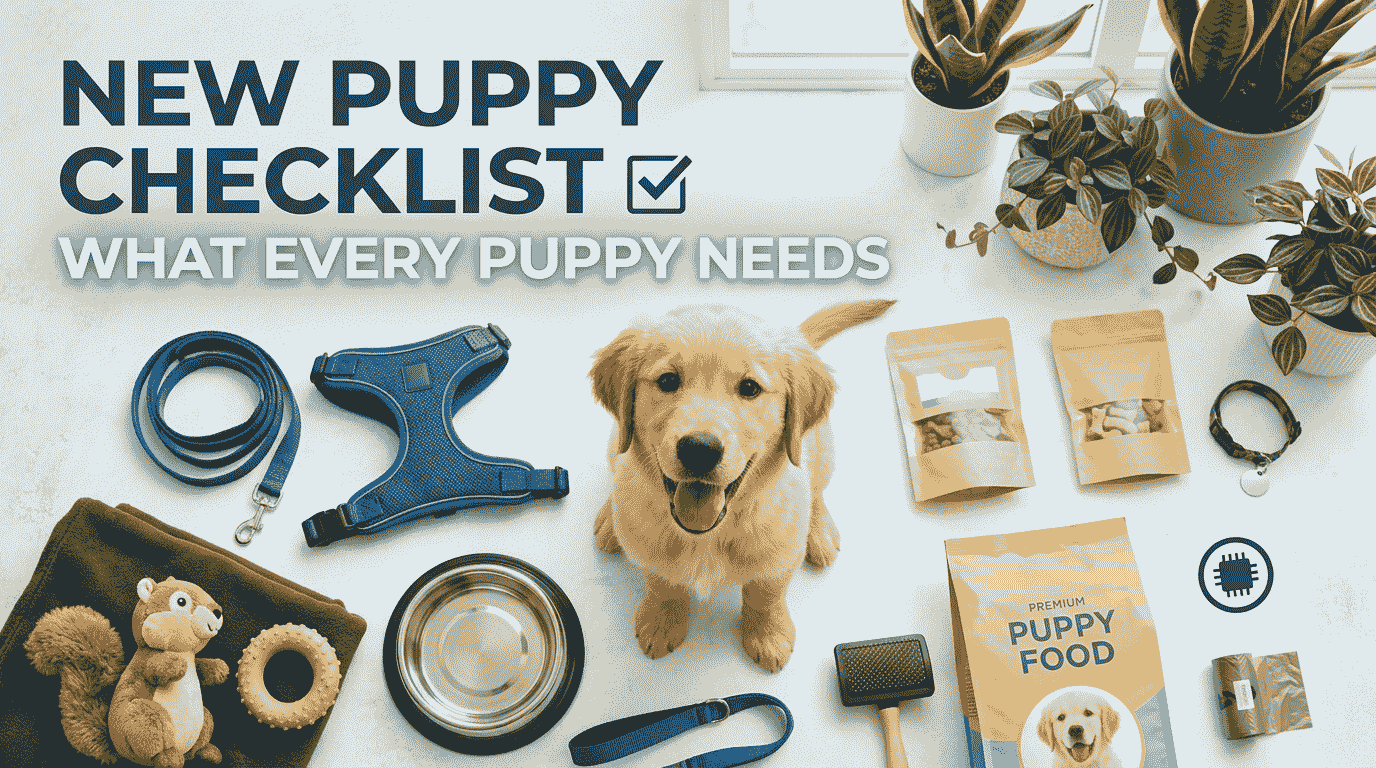
Bringing home a puppy? Here’s the checklist that covers what actually matters — not the 40-item list that gets you overspending on day one.
You’ve got the crate in the car, a folder of vet records nobody explained clearly, and a puppy who’s about to throw up on the seat because car rides are new and terrifying. That’s more or less how it starts for most people. Not with a tidy shopping list. With a small animal who trusts you completely and has no idea what a doorbell is yet.
Most puppy checklists online are just pet store inventory lists dressed up as advice — forty items, half of which sit in a drawer by week three. Here’s what actually matters, roughly in the order you’ll need it, based on what trips people up in the first few weeks rather than what looks good in a product photo.
Before the Puppy Comes Home
Crate, sized correctly. Not “grows into it” sized — correctly sized for right now, big enough to stand, turn around, and lie down, nothing more. A crate that’s too big defeats the point, because a puppy will just use the extra space as a bathroom corner and sleep on the other side. Wire crates with a divider panel let you resize as the puppy grows without buying three crates.
Food, the same brand the breeder or shelter was using. Switching food immediately, on top of every other change happening at once, is a fast route to a stomach that’s already upset from the car ride getting worse. Transition slowly over a week or two if you want to switch eventually.
A vet appointment already booked, ideally within the first 48 to 72 hours. Not because something’s necessarily wrong — because you want a baseline before anything is wrong, and most breeders and shelters recommend it as a condition of the health guarantee anyway.
The First 72 Hours
This stretch is rougher than people expect. A puppy who was just pulled away from littermates, put in a car, and dropped into an unfamiliar house with unfamiliar smells is going to cry at 3am. That’s not a training failure. That’s a baby animal experiencing the biggest change of its short life so far.
What actually helps:
- A warm hot water bottle wrapped in a towel near the sleeping area, mimicking the body heat of littermates.
- A ticking clock or white noise machine, same idea — some breeders swear the ticking mimics a heartbeat, and whether or not that’s literally true, it does seem to settle a lot of puppies.
- Keeping the first few days low-key. No big family gathering, no trip to three different friends’ houses to show the puppy off. The nervous system needs a few days to find a baseline before it can handle novelty.
Potty Training Supplies That Actually Get Used
Puppy pads get recommended constantly and used inconsistently, mostly because most people end up doing outdoor training from day one anyway and the pads just sit there. What consistently helps:
- An enzymatic cleaner, specifically for pet accidents, not general household cleaner. Regular cleaner doesn’t fully break down the scent markers, and a puppy will find and reuse a spot that still smells faintly like a bathroom to them even after it looks clean to you.
- A consistent potty spot outside, same corner of the yard every time for the first few weeks, before it matters less.
- High-value treats reserved only for successful outdoor potty trips — not the same treats used for sit and stay, something the puppy only gets for this one specific win.
Chew Items, Realistically
A teething puppy will chew. The question isn’t whether — it’s what. Skip the giant bin of forty toys and get a handful of genuinely different textures: something hard and rubber, something rope-based, something soft and plush for comfort chewing, and a frozen washcloth for the worst of the teething pain around three to four months.
Rawhide gets recommended less than it used to — it can splinter and cause choking risk in enthusiastic chewers. Bully sticks and specifically-designed teething chews have mostly replaced it in current vet guidance.
The Collar-Versus-Harness Question
Puppies grow fast, sometimes doubling in size within a month or two depending on the breed, so buying an expensive adjustable harness immediately is often money spent on something that’ll be too small by the time it’s broken in. A basic, cheap, adjustable harness for the first few months, upgraded once growth slows down, tends to be the more practical order of operations.
A flat collar with ID tags should go on early regardless, even for indoor-only puppies, because escape happens fastest exactly when nobody expects it — a door left open half a second too long, a gate that didn’t latch.
Socialization Timing Nobody Tells You Clearly
There’s a specific window, roughly between three and fourteen weeks old, where puppies absorb new experiences — people, sounds, other animals, textures underfoot — with far less fear response than they will later. This window closes gradually, not on a specific day, but it does close.
The catch: full vaccination isn’t usually complete until somewhere around sixteen weeks, which puts the ideal socialization window right in the middle of the higher-risk period for illness. Most current vet guidance favors carefully managed exposure — carried outings, controlled meetings with known-vaccinated dogs, puppy classes held in sanitized indoor spaces — over waiting until vaccines are fully done and missing the window entirely.
What Training Actually Needs to Start Immediately
Not obedience commands. Handling.
Getting a puppy comfortable with having their paws touched, their mouth opened, their ears checked, being picked up and gently restrained — this matters more in the first weeks than sit or stay does, because it’s what makes vet visits, nail trims, and grooming manageable for the entire rest of the dog’s life. A puppy who’s had their paws handled calmly fifty times by twelve weeks old is a dramatically easier adult dog at the groomer than one who hasn’t.
Baby-Gates and Puppy-Proofing, Realistically
Full house access on day one is a setup for both accidents and chewed baseboards. A gated section — kitchen, mudroom, whatever area has easy-clean flooring — gives the puppy a manageable space while house training is still unreliable. Expand access gradually as accidents become rare, not on a fixed schedule.
Puppy-proofing checklist that actually matters: cords tucked or covered, anything chewable at nose height removed, cabinets with chemicals secured, small objects picked up off the floor. Skip the elaborate baby-proofing kits — most of it is overkill for a puppy’s specific chewing and swallowing risks.
Pet Insurance, If You’re Going to Get It
The window that makes financial sense is early, before any condition shows up on record, because pre-existing condition exclusions apply the moment something’s diagnosed. Waiting to see if the puppy seems healthy first defeats the purpose — insurance is for the things nobody sees coming, not for confirmed healthy puppies.
The Realistic Version of the First Month
Sleep gets disrupted for a couple of weeks. Something gets chewed that shouldn’t have been. There’s at least one accident indoors after you were sure house training was clicking. None of that means anything’s going wrong — it means a puppy is doing exactly what puppies do while their nervous system, bladder control, and understanding of the world all catch up to the pace everyone wishes they’d move at.
The checklist matters less than the pacing. Crate, food, vet visit, enzymatic cleaner, a handful of chew options, a plan for the first 72 hours, gentle handling practice, and socialization started early but carefully — that’s the actual list. Everything else is optional, and most of it can wait until week three, when you’ll have a much clearer sense of what this particular puppy actually needs.
FAQ
What does a puppy need on the very first day?
A correctly sized crate, the same food they were already eating, a scheduled vet visit within 48–72 hours, and a low-key first day with minimal visitors or outings.
What size crate should I get for a puppy?
Size it for the puppy’s current size, not their adult size — just enough room to stand, turn, and lie down. A wire crate with a divider panel lets you resize it as they grow instead of buying multiple crates.
When should puppy socialization start?
Roughly between three and fourteen weeks old, which usually overlaps with the vaccination period. Most vets recommend carefully managed exposure — carried outings, controlled playdates with vaccinated dogs — rather than waiting until vaccines are fully complete.
Do puppies need pet insurance right away?
Getting it early, before any condition is diagnosed, matters because pre-existing condition exclusions apply the moment something shows up on a vet record.
How long does it take for a puppy to be house trained?
Most puppies show real consistency somewhere between four and six months, though full reliability can take longer depending on breed and consistency of training.